Storm Damage Tree Removal vs Regular Tree Removal
Storm damage tree removal vs regular tree removal in Georgia: what changes, what it costs, how insurance works, and when you need a 24/7 emergency crew.
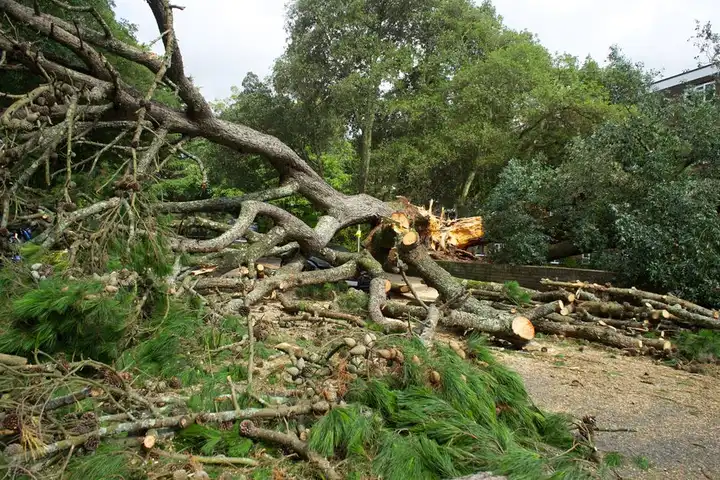
Storm damage tree removal is an emergency service that handles trees already down, split, or leaning on a structure, while regular tree removal is a planned job on a standing tree that is not an immediate hazard. In Georgia, the practical difference shows up in three places: response time, equipment, and how the work gets billed to your insurance. The rest of this post breaks down those differences, what each service costs in 2026, and how to decide which one you actually need.
The Short Answer: Storm Damage vs Regular Tree Removal
Storm damage tree removal vs regular tree removal in Georgia comes down to urgency and risk. A regular removal is scheduled days or weeks out, the tree is upright, and the crew works at a controlled pace. A storm damage removal happens within hours, the tree is often on a roof, a fence, or a power drop, and the crew is managing tension, weight, and live hazards the whole time.
That difference is why the two jobs use different insurance codes, different equipment, and often different crews. It is also why a quote you got last spring for a standing oak has almost nothing to do with what a storm-damaged oak will cost you today.
What Is the Difference Between Storm Damage and Regular Tree Removal in Georgia?
The difference between storm damage and regular tree removal in Georgia is the condition of the tree when the crew arrives. A regular removal starts with a tree that is standing, rooted, and predictable. A storm damage removal starts with a tree that has already failed - uprooted, snapped, split, or leaning at an angle that could finish falling at any moment.
Here is how the two jobs actually break down on a Georgia property:
- Regular tree removal: tree is upright, you pick the date, the crew plans the drop, and cleanup is usually included in a flat quote.
- Storm damage tree removal: tree is down or unstable, you call at 2 a.m., the crew stabilizes first and cuts second, and cleanup may be a separate line item for insurance.
- Regular removal timeline: booked 3-10 days out in most Georgia markets.
- Storm damage timeline: on-site within 1-4 hours for true emergencies, longer during a county-wide outage event.
- Regular removal equipment: bucket truck, chipper, ground crew.
- Storm damage equipment: crane or rigging lines, pole saws, chainsaws, sometimes a second truck for a two-point lift.
One more difference most homeowners miss: a regular removal is almost always elective. You can wait a week. A storm-damaged tree on a structure is not elective - every hour it sits, the weight shifts, and the damage to your roof, siding, or foundation grows. That is the whole reason we run 24/7 Tree Removal in Georgia instead of a Monday-through-Friday schedule.
Why Storm Damage Tree Removal Costs More in Georgia
Storm damage tree removal costs more in Georgia because the job is harder, slower, and more dangerous than a planned removal of the same tree. A 60-foot pine that is standing straight might come down in two hours. The same pine lying across a garage takes four to six hours, a crane, and two extra crew members to lift it off without collapsing the structure underneath.
Typical 2026 pricing in this area runs like this:
- Regular removal, small tree (under 30 ft): $350-$700.
- Regular removal, medium tree (30-60 ft): $700-$1,500.
- Regular removal, large tree (60+ ft): $1,500-$3,000.
- Storm damage removal, tree on the ground: $500-$1,800.
- Storm damage removal, tree on a structure: $1,500-$5,000+.
- Emergency crane assist: $800-$2,000 added to the base job.
The premium is not a storm surcharge. It is the cost of rigging, crane time, and the liability of working under a load that could shift without warning. When a crew has to cut a trunk that is holding up a section of your roof, every cut is calculated. That takes time, and time is what you are paying for.
If the tree is still standing but leaning toward the house, the job sits somewhere in between. We treat those as Leaning Tree Removal in Georgia because the tree has not failed yet - but it will, and the price of dealing with it now is a fraction of the price after it lands on your bedroom.
Does Insurance Cover Storm Damage Tree Removal in Georgia?
Insurance usually covers storm damage tree removal in Georgia when the tree hits a covered structure - your house, garage, shed, or fence. If the tree simply falls in the yard and hits nothing, most Georgia policies will not pay for the removal, though some will cover a few hundred dollars for hauling the debris off a driveway or access path.
What adjusters actually look at:
- Did the tree hit a covered structure? If yes, removal is typically covered up to policy limits.
- Was the tree healthy before the storm? A dead or diseased tree that you knew about can be denied.
- Was the storm a named event? Hurricane and tropical storm claims in Georgia are handled differently from a random summer thunderstorm.
- Did you mitigate further damage? Tarping a roof or moving a limb off a car usually helps the claim, not hurts it.
Document everything before the crew starts: photos of the tree, photos of the damage, and a written scope from the removal company. We provide that scope on every storm job so you can hand it straight to your adjuster. If the storm was a named system, the claim often falls under Tree Removal After Hurricane in Georgia rules, which have their own deductible in most policies.
When Do You Need Emergency Tree Removal in Georgia?
You need emergency tree removal in Georgia when a tree is on a structure, blocking a driveway or access road, resting on a power line, or leaning in a way that could hit something within the next few hours. Those are the four situations where waiting until morning can turn a $1,500 job into a $15,000 insurance claim.
Call immediately if any of these are true:
- The trunk is resting on your roof, garage, or a vehicle.
- The tree is blocking the only way in or out of your property.
- Branches are touching or resting on power lines - do not touch the tree yourself.
- The root plate has lifted and the trunk is tilting more than 15 degrees from vertical.
- You can hear wood cracking or popping after the storm has passed.
If none of those apply - the tree is down in an open yard, nothing is damaged, and nobody is at risk - you can wait for a scheduled removal and save money. That is a regular job, not an emergency.
Can a Regular Tree Crew Handle Storm Damage in Georgia?
A regular tree crew can handle storm damage in Georgia only if the tree is already on the ground and clear of structures, wires, and people. The moment a tree is on a roof, tangled in a power drop, or under tension from a split trunk, you need a crew trained and equipped for storm work.
The gap is not skill - it is equipment and insurance. A standard removal crew carries a bucket truck and a chipper. A storm crew carries rigging gear, a crane, and the general liability coverage that lets them work over a structure without leaving you exposed if something goes wrong. Many standard crews will simply decline a tree-on-house job because their insurance will not cover the lift.
This is also where the licensing question matters. In Georgia, tree work over a certain height and any work near energized lines requires specific certifications. Ask for them. A crew that cannot show them should not be cutting a tree off your roof.
Common Mistakes Homeowners Make After a Georgia Storm
The most expensive mistake homeowners make after a Georgia storm is hiring the first truck that shows up with a chainsaw and a magnetic sign. Storm events bring out-of-state crews who mean well but do not know local soil, local codes, or your insurance adjuster's expectations.
Watch out for these:
- Paying cash up front. A legitimate storm crew bills after the work or works directly with your insurer.
- Skipping the photo documentation. Once the tree is cut, your claim gets harder, not easier.
- Letting a crew cut before the adjuster sees it. Emergency stabilization is fine; full removal before an adjuster visit can complicate the payout.
- Assuming the cheapest quote is the real price. Storm quotes often exclude crane time, stump grinding, and debris hauling.
- Ignoring a leaning tree because it did not fall. A tree that leans after a storm has already told you it is failing.
If you are not sure whether a tree qualifies as storm damage or just needs a standard removal, that is a five-minute phone call, not a guess. We would rather tell you it can wait than send a crew out at 3 a.m. for a tree that is not going anywhere.
When to Call a Professional
Call a professional the moment a tree is touching a structure, a vehicle, or a power line, or when a trunk is leaning and you cannot tell how stable it is. Those are not DIY jobs, and they are not jobs for a neighbor with a ladder and a chainsaw.
Our team at Georgia 24/7 Tree Removal handles both sides of this - planned removals and true storm emergencies. We stabilize first, cut second, and leave the property safe to walk through before we pull out. If you are in one of the metro areas hit hardest by summer storms, you can also reach us directly through our Emergency Tree Removal in Atlanta page, where we run the same crew and the same equipment.
Frequently Asked Questions
What is the difference between storm damage and regular tree removal in Georgia?
Storm damage removal handles a tree that has already failed - down, split, or leaning on a structure - usually within hours. Regular removal is a scheduled job on a standing, stable tree, booked 3-10 days out. The work, equipment, and insurance handling are different.
Is storm damage tree removal more expensive in Georgia?
Yes. Expect $1,500-$5,000+ for a tree on a structure versus $700-$1,500 for a comparable standing removal. The premium covers crane time, rigging, and the added liability of working under a load that can shift.
Does insurance cover storm damage tree removal in Georgia?
Usually, if the tree hits a covered structure like your house, garage, or fence. If it falls in an open yard and hits nothing, most Georgia policies will not pay for removal, though some cover a few hundred dollars for debris hauling.
When do I need emergency tree removal in Georgia?
When a tree is on a structure, blocking your only access, resting on a power line, or leaning more than 15 degrees after a storm. If none of those apply, a scheduled removal is cheaper and just as safe.
Can a regular tree crew handle storm damage in Georgia?
Only if the tree is already on the ground and clear of structures and wires. A tree on a roof or under tension needs a storm-trained crew with rigging gear, a crane, and the insurance coverage to work over a structure.
Get Help with Emergency Tree Removal in Georgia
If a tree is on your house, your car, or your only driveway right now, do not wait for business hours. We run crews around the clock across Georgia and we will tell you honestly whether it is an emergency or a job that can wait until morning.
Call Georgia 24/7 Tree Removal at +18664591318 and we will get a crew moving toward you.